
IV Iron & Iron Toxicity: An Evidence-Informed Perspective
You may have come across conversations suggesting that intravenous (IV) iron can lead to “toxic” levels of iron in the bloodstream or contribute to oxidative stress.
These concerns deserve thoughtful discussion.
Iron can participate in oxidative reactions, and excessive iron can be harmful. At the same time, IV iron is an established medical treatment used to replenish iron when clinically appropriate.[1–3]
Rather than dismissing concerns or reducing a complex topic to a simple “true or false,” we believe it is more helpful to look at what the available evidence tells us, acknowledge where important nuances exist, and help you better understand what happens when IV iron enters the body.
Our goal is not to tell you what to think.
It is to provide clear, evidence-informed information so you feel comfortable asking questions, discussing your concerns with your healthcare provider, and participating in decisions about your care.
The Journey of IV Iron: From Infusion to the Cells That Need It
To understand conversations about IV iron, oxidative stress and iron toxicity, it helps to first understand what happens to iron after an infusion.
IV Iron Bypasses the Gut
When we consume iron through food or take an oral iron supplement, that iron must first travel through the gastrointestinal tract and be absorbed through the intestine.
IV iron takes a different route.
Because it is administered directly into a vein, IV iron bypasses intestinal absorption altogether.[1,4]
This can be particularly useful when oral iron is poorly tolerated, inadequately absorbed, ineffective, or when there is a clinical need to replace iron more efficiently.[1]
IV Iron Is More Than Simply “Iron in the Blood”
Modern IV iron formulations consist of an iron-containing core surrounded and stabilized by a carbohydrate structure.[2,5]
You can think of this structure as a carefully designed delivery system.
The goal is not to introduce a large amount of freely circulating, unbound iron into the bloodstream. Instead, the iron-carbohydrate complex is designed to control how iron is released and becomes available to the body.[2,5]
Different IV iron formulations have different molecular structures and levels of stability, which can influence how they are processed and how readily iron is released.[2,5]
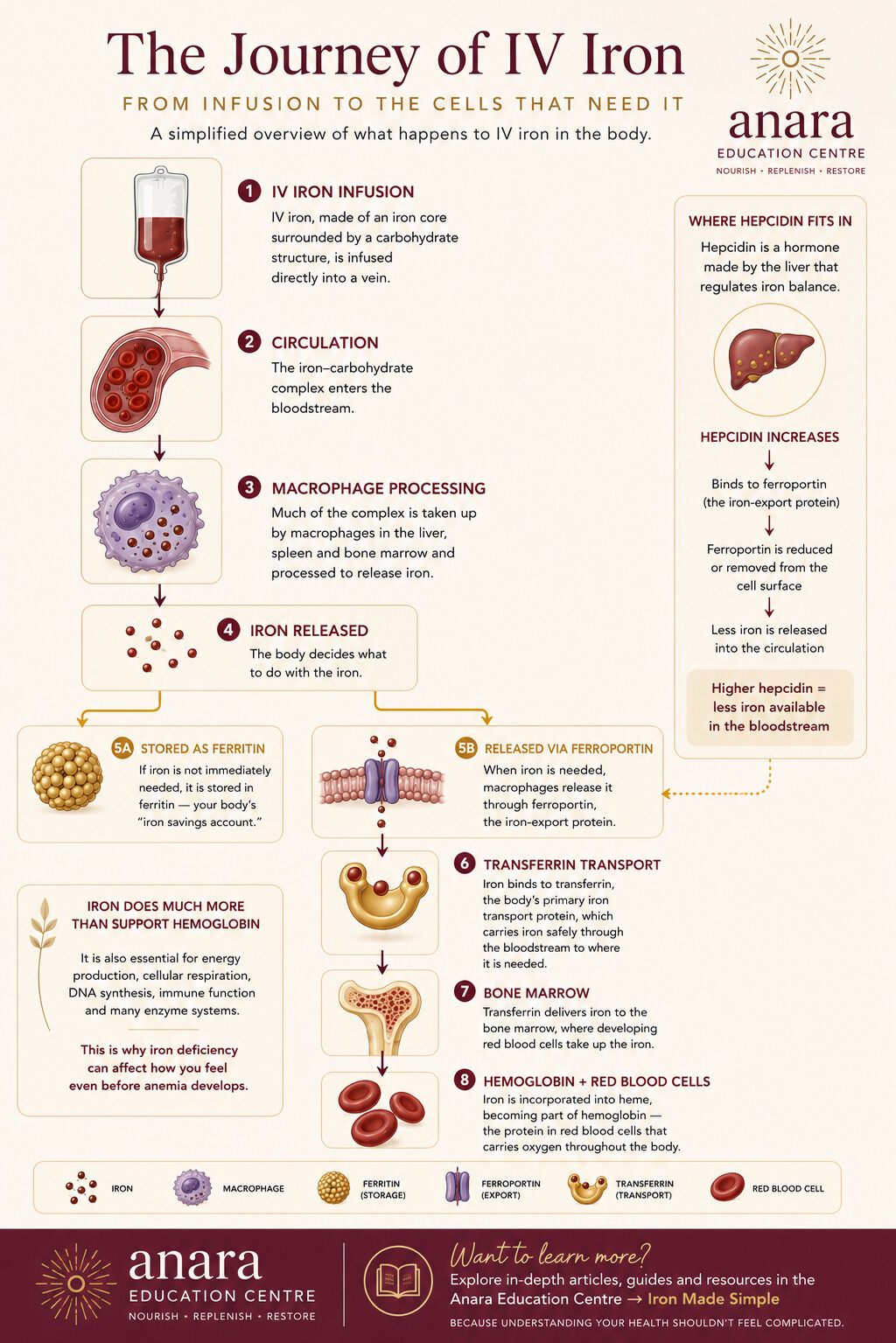
Step 1: IV Iron Enters the Circulation
Following an infusion, the iron-carbohydrate complex enters the bloodstream.
Much of the complex is subsequently taken up and processed by macrophages, particularly within the liver, spleen and bone marrow.[1,2]
Macrophages are cells that already play an important role in the body's normal system of iron recycling and regulation.
Step 2: The Iron Complex Is Processed
Within macrophages, the iron-carbohydrate complex is processed and iron becomes available for storage or transport.[1,2]
The body can then use that iron according to its needs.
Step 3: Iron Can Be Stored as Ferritin
If iron is not immediately required, it can be incorporated into ferritin, one of the body's primary iron-storage proteins.[1,2]
This is why we often describe ferritin as the body's “iron savings account.”
When iron stores have become depleted, IV iron can help replenish those reserves.
Ferritin commonly increases following IV iron administration as iron stores are replenished.[2] An increase in ferritin following an infusion is therefore expected and, by itself, does not demonstrate iron toxicity.
Step 4: Iron Can Be Released Through Ferroportin
When stored iron is needed elsewhere in the body, macrophages can release it through a specialized iron-export protein called ferroportin.[1,4]
You can think of ferroportin somewhat like a doorway that allows iron to leave the cell.
Once released, however, iron needs a safe way to travel through the bloodstream.
That's where transferrin comes in.
Step 5: Transferrin Transports Iron
Transferrin is the body's primary iron-transport protein.
It binds iron and carries it through the circulation to tissues that need it.[2,4]
If ferritin is your body's iron savings account, transferrin is its iron transportation system.
This distinction is important because certain forms of unbound iron can be highly reactive.
Binding iron to proteins such as transferrin allows the body to transport iron between tissues while limiting exposure to reactive iron species.[2,3]
Step 6: Iron Reaches the Bone Ma
One of transferrin's most important destinations is the bone marrow.
Developing red blood cells have transferrin receptors on their surface. Iron-loaded transferrin binds to these receptors, allowing iron to enter the developing cell.[2,4]
The iron can then be incorporated into heme, which becomes part of hemoglobin.
Hemoglobin is the protein inside red blood cells responsible for carrying oxygen throughout the body.
The Journey of IV Iron at a Glance'
Iron Isn't Only for Hemoglobin
Although iron is often discussed in relation to hemoglobin and anemia, its role extends far beyond red blood cell production.
Iron participates in numerous fundamental biological processes, including mitochondrial energy production, cellular respiration, DNA synthesis and iron-dependent enzyme systems.[7,8]
This is also one reason iron deficiency can exist before anemia develops.[7]
A person can have depleted iron stores while their hemoglobin remains within the laboratory reference range.
In other words, the body requires iron for much more than simply maintaining a hemoglobin number.
Where Does Hepcidin Fit In?
There is another important player in iron regulation: hepcidin.
Hepcidin is a hormone produced primarily by the liver and is considered one of the body's major regulators of iron balance.[1,4]
Hepcidin interacts directly with ferroportin.
When hepcidin levels increase, it binds to ferroportin and leads to its internalization and degradation. This reduces the amount of iron that can leave macrophages and also decreases the movement of dietary iron from intestinal cells into the circulation.[4]
In simpler terms:
Higher hepcidin → less iron available to move into the bloodstream
Lower hepcidin → more iron can move into the bloodstream
Hepcidin can increase in response to inflammation. This helps explain why some people living with chronic inflammatory conditions can have iron stored within the body but have difficulty making that iron available to tissues that need it.[1,4]
This can contribute to what is often described as functional iron deficiency or iron restriction.
It is also one reason a person's iron status cannot always be understood by looking at a single laboratory value in isolation.
So Where Does Non-Transferrin-Bound Iron Fit?
This brings us back to the conversation about oxidative stress.
Remember how we described transferrin as the protein that safely carries iron through the bloodstream?
Transferrin has a limited capacity to carry iron.
Research has demonstrated that following IV iron administration, some iron can temporarily appear in the circulation without being bound to transferrin. This is known as non-transferrin-bound iron, or NTBI.[6]
How much appears, when it appears and how long it remains can vary among IV iron formulations because their molecular structures, stability and pharmacokinetics are different.[5,6]
Why Does This Matter?
Some forms of NTBI are more reactive than others.
A particularly reactive component, often referred to as labile plasma iron, can participate in chemical reactions that contribute to the formation of reactive oxygen species (ROS).[3,6]
When reactive oxygen species are produced faster than the body's antioxidant systems can manage them, oxidative stress can occur.[3]
This is a real and important part of iron physiology and deserves to be acknowledged.
But it also requires context.
Finding a temporary increase in NTBI after an iron infusion does not mean that someone has developed iron toxicity or that harmful oxidative damage is occurring throughout the body.
Research comparing different IV iron formulations has demonstrated transient NTBI following administration, with meaningful differences between formulations.[6]
Importantly, detecting a temporary biochemical change is not the same as demonstrating that the change is causing clinically meaningful harm.
That distinction matters.
Iron Overload Is Real. Oxidative Stress Is Real. And Iron Deficiency Is Real.
Discussions about IV iron sometimes focus heavily on what might happen if the body receives too much iron.
That is an important conversation.
But it should not be the only one.
Leaving iron deficiency untreated can also have meaningful consequences for health, function and quality of life.[7,8]
Iron deficiency may occur before anemia develops, and because iron is required for numerous cellular processes, the effects of deficiency are not limited to hemoglobin alone.[7,8]
This is where appropriate assessment becomes so important.
IV iron is not a treatment that everyone needs.
Before an infusion, a qualified healthcare provider should consider the individual's laboratory findings, symptoms, medical history, possible cause of their iron deficiency, previous response or tolerance to oral iron, and whether IV iron is an appropriate treatment option for them.[1]
But when iron deficiency has been identified and IV iron is clinically indicated, the goal of treatment is not to give the body “too much” iron. It is to appropriately replace iron that the body is lacking.
For some people, oral iron may be an appropriate first step.
For others, oral iron may not be tolerated, may not be adequately absorbed, may not sufficiently correct the deficiency, or there may be a clinical reason why iron needs to be replaced more efficiently.[1]
In these situations, IV iron can provide an important and effective method of replenishing depleted iron stores.[1]
The conversation therefore should not only consider the potential risks of receiving iron.
It should also consider the potential consequences of not adequately treating iron deficiency when treatment is needed.
Why Individualized Care Matters
Iron therapy should never simply be about chasing a laboratory number.
The goal is to identify iron deficiency appropriately, understand why it developed, consider the person's symptoms and overall clinical picture, and determine the most appropriate way to replace the iron that has been lost.
That may look different from one person to another.
For some, oral iron may be appropriate.
For others, IV iron may be the more appropriate treatment.
And for others, further investigation may be needed before either is considered.
Appropriate assessment helps determine who may benefit from IV iron. Appropriate treatment helps ensure that people who need iron replacement receive it.
At Anara, our goal is not to tell you what to think or to suggest that one treatment is right for everyone.
Our goal is to provide thoughtful, evidence-informed education so you can better understand your iron health, ask informed questions and participate confidently in conversations about your care.
Because healthcare education should help you feel informed, heard and empowered to participate in decisions about your own health.
References
1. Richards T, Breymann C, Brookes MJ, et al. Questions and answers on iron deficiency treatment selection and the use of intravenous iron in routine clinical practice. Annals of Medicine. 2021;53(1):274–285.
2. Bhandari S, Pereira DIA, Chappell HF, Drakesmith H. Intravenous irons: from basic science to clinical practice. Pharmaceuticals (Basel). 2018;11(3):82.
3. Koskenkorva-Frank TS, Weiss G, Koppenol WH, Burckhardt S. The complex interplay of iron metabolism, reactive oxygen species, and reactive nitrogen species: insights into the potential of various iron therapies to induce oxidative and nitrosative stress. Free Radical Biology and Medicine. 2013;65:1174–1194.
4. Camaschella C. Iron-deficiency anemia. New England Journal of Medicine. 2015;372:1832–1843.
5. Neiser S, Rentsch D, Dippon U, et al. Physico-chemical properties of the new generation IV iron preparations ferumoxytol, iron isomaltoside 1000 and ferric carboxymaltose. BioMetals. 2015;28:615–635.
6. Garbowski MW, Bansal S, Porter JB, Mori C, Burckhardt S, Hider RC. Intravenous iron preparations transiently generate non-transferrin-bound iron from two proposed pathways. Haematologica. 2021;106(11):2885–2896.
7. Al-Naseem A, Sallam A, Choudhury S, Thachil J. Iron deficiency without anaemia: a diagnosis that matters. Clinical Medicine (London). 2021;21(2):107–113.
8. Abbaspour N, Hurrell R, Kelishadi R. Review on iron and its importance for human health. Journal of Research in Medical Sciences. 2014;19(2):164–174.
Canadian Product Information
9. Health Canada. Monoferric® (ferric derisomaltose) Product Monograph. Pharmacosmos A/S. Canadian prescribing information.
This article is intended for educational purposes only and does not replace individualized medical assessment, diagnosis or treatment recommendations from a qualified healthcare professional.

Zenaida Boerhave
Contact Me